
The problem with rules of thumb
Why guessing costs you either way
An undersized system leaves you still paying peak-rate grid power every evening, which is when Townsville households use the most — aircon, cooking, TV, and charging everything overnight. An oversized system means you’re exporting excess power back to the grid for a few cents a kWh instead of using it yourself, which stretches out your payback period for no real benefit. The right size sits at the point where your generation matches what you actually use, not what a generic size like “6.6kW because that’s standard” happens to land on.
Pick whichever you have data for
Three ways to work out your number
Roof space: the ceiling on any system
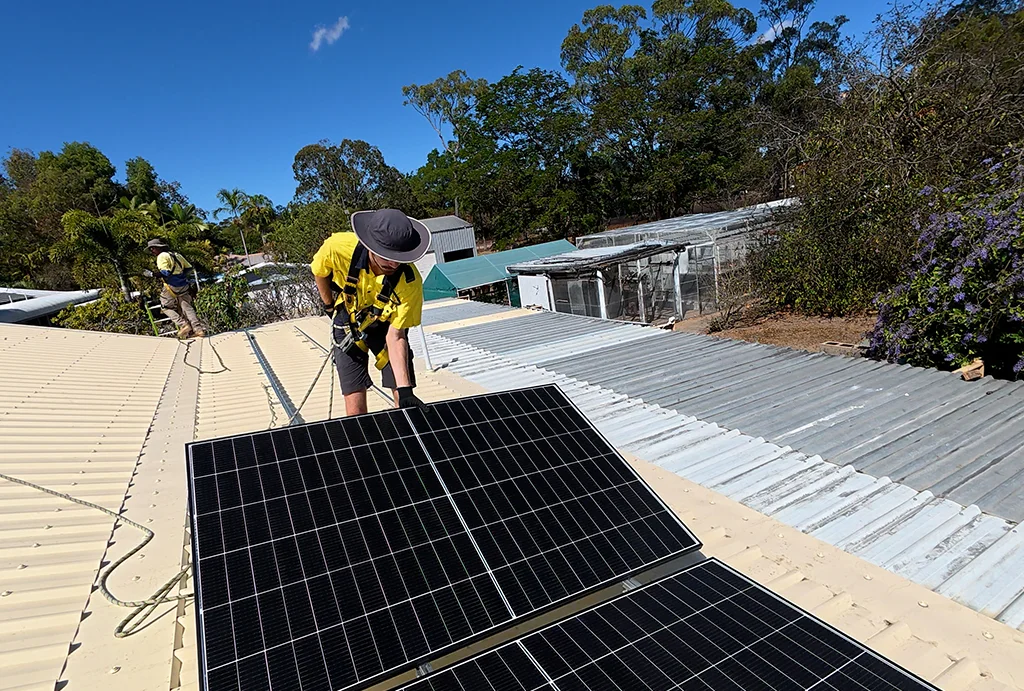
A standard 440–450W panel measures roughly 1.8m x 1.1m — about 2m² including mounting clearance. Before assuming a size is achievable, we measure your usable, unshaded roof area and subtract anything that eats into it: roof vents, whirlybirds, hip-roof corners, and shading from trees, chimneys or a neighbouring second storey at different times of day.
Most Townsville homes are either a hip roof (common on newer builds, which splits panels across several smaller faces) or a gable/Queenslander-style roof (fewer, larger faces, often easier to fill efficiently). Colorbond and tin roofs, which make up most of Townsville’s housing stock, mount panels straightforwardly; tile roofs need a bit more care around the mounting brackets but aren’t a barrier.
If your roof space caps you below what your usage would otherwise call for, that’s worth knowing before you commit to a number — it may mean prioritising your highest-usage circuits, or considering a battery to get more value from a smaller array.
The bill method, worked through
Townsville gets around 5.5 peak sun hours a day on average across the year — among the highest in Australia, though the wet season (roughly December to March) brings more overcast days that pull the average down for those months. A well-oriented system typically converts that to usable output at around 80% efficiency once you account for inverter losses, panel temperature derating (North Queensland heat does reduce panel output slightly) and system losses.
Rough formula: Average daily usage (kWh) ÷ 5.5 sun hours ÷ 0.8 = approximate system size in kW.
Worked example: A household averaging 28 kWh a day (a fairly typical 3–4 person Townsville home with aircon) would land at 28 ÷ 5.5 ÷ 0.8 ≈ 6.4 kW — which is roughly why 6.6kW became the “standard” size in the first place. A household averaging 42 kWh a day (larger family, pool pump, more aircon use) lands closer to 42 ÷ 5.5 ÷ 0.8 ≈ 9.5 kW, which is why 9.9kW systems are common for bigger Townsville households.
This gets you in the right range, but doesn’t account for your specific roof orientation, shading, or whether you’re planning to add a battery, EV charger or pool down the track — which is where a proper site assessment matters more than any formula.
What each size actually suits
Common system sizes for Townsville homes
| System size | Typical Townsville household | Approx. daily generation* | Panels (at 440W) |
|---|---|---|---|
| 5kW | 1–2 people, low-moderate aircon use, no pool | ~20–22 kWh/day | ~11–12 panels |
| 6.6kW | 2–4 people, standard aircon use | ~26–29 kWh/day | ~15 panels |
| 9.9kW / 10kW | 4–6 people, multiple aircon zones, pool pump | ~40–44 kWh/day | ~22 panels |
| 13kW+ | Larger households, EV charging, planning to add a battery | ~52kWh+/day | ~29+ panels |
*Approximate figures based on Townsville’s average annual sun hours and typical system losses. Actual generation varies with roof orientation, tilt, shading and season — we confirm exact figures for your roof as part of a site assessment.
Local factors that change the maths
What's different about sizing for Townsville
What we check that a calculator can't
Why a site assessment beats any formula
The methods above will get you close, but they can’t see your actual roof. On site, we check things a formula never will: real shade patterns from trees or nearby buildings across the day and seasons, which roof faces are structurally suitable, whether your switchboard and meter can handle the system size you want, and any export limits your network operator applies in your area. We’ll also confirm what you’re eligible for under current state and federal rebates before we finalise a number, so the size we quote is the size you actually get installed.
Solar and battery sizing aren't the same maths
If you're adding a battery, size differently
A solar-only system is sized to cover your daytime usage. Add a battery and the goal shifts to generating enough surplus during the day to also cover your evening usage — which usually means sizing the panels slightly larger than a solar-only system would need. If you’re planning to add a battery now or later, it’s worth reading our battery comparison guide and looking at solar and battery packages before locking in a panel size, and checking your eligibility for the federal battery rebate.
Common questions
Solar sizing questions, answered
What size solar system do I need for a 3-4 bedroom home in Townsville?
Most 3–4 bedroom Townsville homes with 2–4 occupants and standard aircon use land somewhere around 6.6kW to 9.9kW, depending on how many aircon zones you run and whether you have a pool pump. The only accurate way to confirm your number is against your actual bill or a site assessment — bedroom count alone doesn’t tell us your usage.
Is 6.6kW or 9.9kW better for me?
It depends on your daily usage, not a general preference. 6.6kW typically suits smaller households with moderate aircon use; 9.9kW suits larger households, multiple aircon zones, a pool pump, or households planning to add a battery or EV charger. Run your average daily kWh through the formula above, or use our system size calculator to get a starting figure.
Will a 5kW system run my air conditioner?
A 5kW system can comfortably power a single aircon zone running during daylight hours, but it won’t cover a household running multiple zones or aircon overnight without drawing from the grid or a battery. If aircon is a big part of your usage, a larger system usually pays for itself faster.
How many solar panels make up a 10kW system?
At the common 440W panel size, a 10kW system needs roughly 22 to 23 panels. The exact count varies slightly depending on the panel wattage used and your inverter configuration.
Do I need a bigger system if I'm adding a battery?
Usually yes, if you want the battery to be fully useful. A battery only stores what your panels generate as surplus during the day, so if your solar-only system is sized to exactly match your daytime usage, there’s little extra to store. We size panels and battery together rather than adding a battery to an existing solar-only system without checking the maths first.
How much does a 9.9kW system actually generate in Townsville?
On average across the year, a well-oriented 9.9kW system in Townsville generates roughly 40 to 44 kWh per day, though this varies by season — higher in the dry season, lower during extended wet-season overcast periods. We provide season-by-season generation estimates specific to your roof as part of every quote.
What size solar system do I need to run a pool pump?
A standard pool pump running several hours a day typically adds somewhere between 3 and 8 kWh to your daily usage depending on the pump size and run time — worth adding to your bill-based calculation separately if you’re planning a pool, since it’s easy to under-budget for.


